Web site: www.se-editor.org
Category: Office
Subcategory: Text Editors
Platform: Linux, BSD, Haiku, Minix, Solaris/OpenIndiana
License: Public Domain
Interface: CLI
Wikipedia: Se (text editor)
First release: 1987
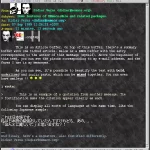
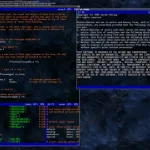
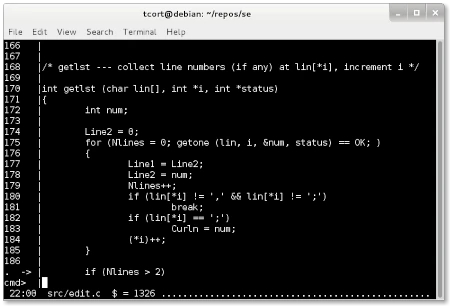
se (screen-editor) – a screen oriented version of the classic UNIX text editor ed. It’s similar to vi as both are modal editors with curses interfaces. However, it differs from vi in that it has the same command syntax as ed.
Features:
– command syntax that is very familiar to users who already know ed.
– full visual interface allowing you to see the text you’re editing.
– built-in help system which describes many of the available commands.
– many configurable options which can be loaded from a .serc file.
– can be run interactively or in a script via the included scriptse utility.
– portable across many platforms.
– will notify you if you have new/unread e-mail.
– optional usage logging.
Se started out as the version of ed that came with the book Software Tools, by Kernighan and Plauger, which was written in Ratfor. On the Pr1me computers at the School of Information and Computer Science at Georgia Tech, Dan Forsyth, Perry Flinn, and Alan Akin added all the enhancements suggested in the exercises in the book, and some more of their own. Jack Waugh made extensive modifications to turn it into a screen editor; further work was done by Dan Forsyth. All of this was in an improved Georgia Tech version of Ratfor.
Later, Dan Forsyth, then at Medical Systems Development Corporation, converted the Ratfor version into C, for Berkeley Unix (4.1 BSD). At Georgia Tech, Arnold Robbins took the C version and added many new features and improvements, the most important of which was termcap support and System V support. The existing help screens were edited and completed at that time, as well. This was completed in early 1985.
In early 2013, Thomas Cort continued maintenance of se, modernizing the code base and build system to support current POSIX operating systems. Thomas’ primary motivation is to preserve this bit of computing history. His goals are to squash any remaining bugs and make se as portable as possible. No major new features will be added.